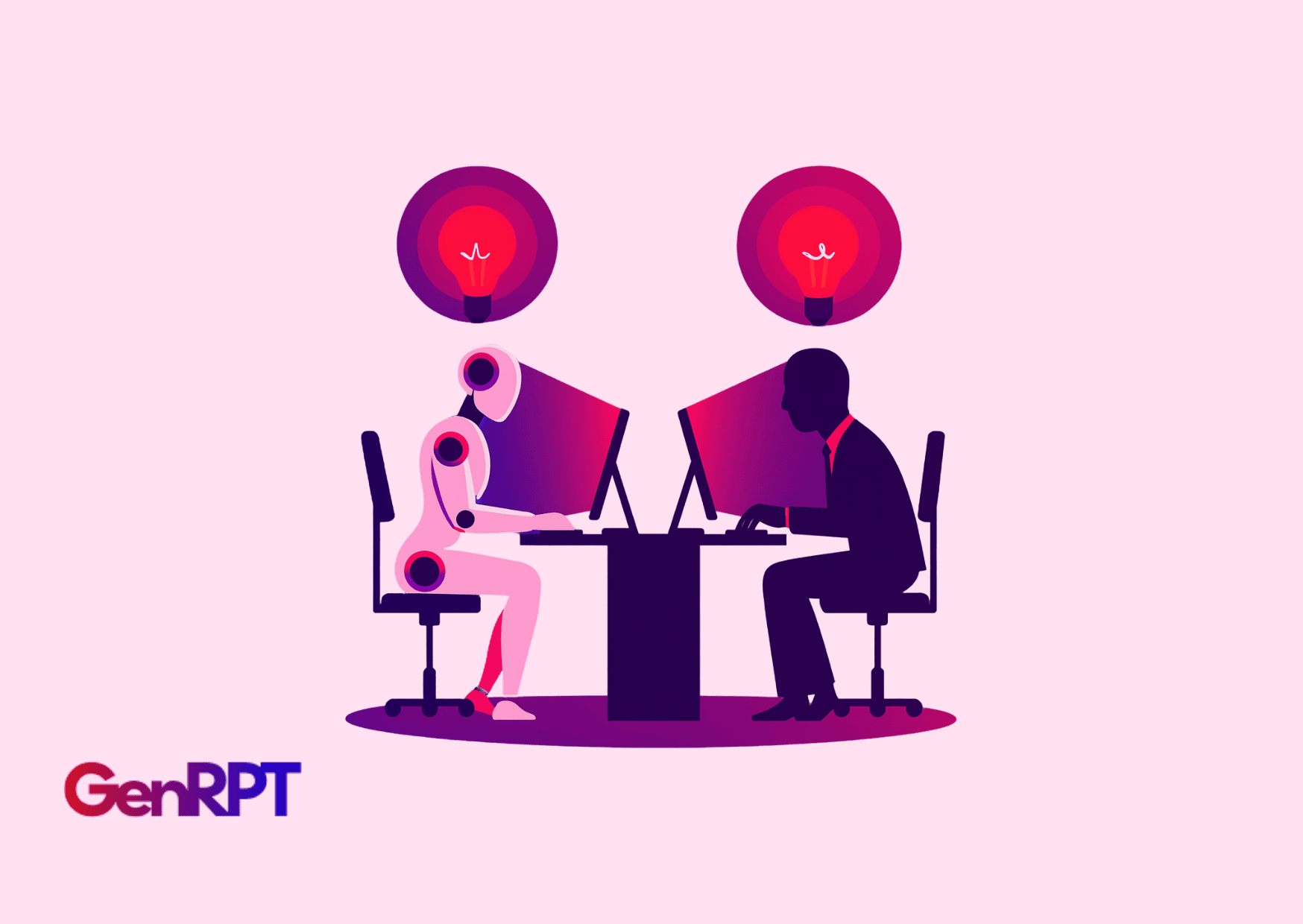
Enterprises around the world are moving from traditional automation to intelligence-driven systems powered by AI, GenAI, and Agentic AI. These technologies no longer operate silently in the background. They participate in daily work—summarizing documents, generating reports, validating data, guiding decisions, answering queries, and assisting teams across finance, supply chain, operations, customer service, manufacturing, and maritime workflows. As AI becomes more capable, one question becomes central: Can humans truly trust the systems they work with? Human–AI collaboration is not just a technology challenge. It is also a behavioral, cultural, and design challenge. Trust determines how comfortably people rely on AI, how confidently they act on AI-generated recommendations, and how responsibly enterprises deploy intelligent systems. This blog explores why trust matters, how collaboration develops, the challenges enterprises face, and how to build AI systems that people accept, understand, and depend on.
Why Human–AI Collaboration Matters Today
Modern AI performs tasks that previously required full human involvement: reading financial reports, summarizing legal and compliance documents, assisting in inspections and risk assessments, generating insights from SQL, Excel, PDFs, or enterprise systems, supporting supply chain visibility, producing multi-format reports, and guiding operators in real time. With GenAI and Agentic AI, systems no longer just respond—they reason, plan, and carry out tasks independently. The goal is not to replace people. The goal is to augment their judgment. Human–AI collaboration creates value in three fundamental ways: Speed, by automating routine tasks instantly; Accuracy, by reducing manual errors and validating inconsistencies; Insight, by giving humans more time to focus on strategy and decision-making. But none of this works unless users trust the AI enough to rely on it.
What Trust in AI Really Means
Trust between humans and AI mirrors trust between colleagues. It grows when the system behaves consistently, communicates clearly, and makes its intent visible. When people trust AI, they rely on recommendations, delegate tasks, and treat the system as a partner. When they do not trust it, they bypass it, double-check everything, reduce adoption, or refuse integration. Trust forms around five qualities:
1. Reliability—the system must produce consistent, correct results.
2. Transparency—users must understand how conclusions were reached.
3. Safety and control—humans must be able to override decisions; risks must be minimized.
4. Alignment with goals—AI must follow enterprise rules, compliance standards, and business expectations.
5. Communication clarity—AI must explain insights in simple, contextual, human-like language. When these qualities are present, AI shifts from being a “tool” to becoming a “trusted assistant.”
The New Era: Agentic AI and Autonomous Functions
Traditional AI responds to prompts. Agentic AI goes further. It can break tasks into steps, call tools, validate its own work, correct errors, execute workflows end to end, and communicate reasoning or confidence levels. Because agentic AI behaves more like a teammate, the trust requirement becomes significantly higher. A user may accept a GenAI summary, but trusting an agentic system to run data validation, scheduling, automated reporting, or regulatory interpretation requires deeper confidence. This is why explainability, auditability, governance, and predictable behavior are becoming essential design principles for enterprise AI systems.
Where Human–AI Collaboration Creates the Highest Impact
1. Reporting and Data Intelligence
Tools like GenRPT use LLMs and agentic workflows to help analysts reclaim hours by extracting data from SQL/NoSQL/PDFs, validating KPIs, generating summaries, and producing board-ready reports. Humans still make final decisions, but trust determines how easily analysts adopt AI-driven workflows.
2. Financial and Risk Decisions
Portfolio managers, risk teams, and financial advisors rely on models, forecasts, and detailed insights. AI systems must cite sources, show calculations, reveal assumptions, and flag anomalies. Trust ensures decisions are based on evidence, not black-box output.
3. Supply Chain and Maritime Operations
In real-time industries like shipping, logistics, warehousing, and maritime safety, AI enables shipment visibility, predictive maintenance, document intelligence, inspection readiness, and safety recommendations. Teams must trust that AI interprets regulations correctly and uses up-to-date operational data such as SOLAS, MARPOL, the ISM Code, PSC protocols, and internal SOPs. Trust enables fast, confident action.
4. Customer-Facing Applications
Chatbots, onboarding agents, and AI-driven support platforms influence customer experience directly. If users distrust AI-generated answers, they abandon the interaction. Trust arises when AI output is accurate, consistent, and respectful.
Challenges in Building Trustworthy AI
Enterprises face several barriers to trust: Lack of transparency, where users cannot see how the AI reached conclusions; Inconsistent output, which makes AI appear unreliable; Conflicting data sources, leading to mismatches; Poor explainability, where AI offers long or technical explanations instead of clarity; Privacy and security concerns, which discourage adoption; and GenAI hallucinations, which weaken trust immediately. These issues show why enterprise-grade AI requires thoughtful design and strong governance.
Principles for Strong Human–AI Collaboration
Trust is built by design, not by accident. Enterprises must create systems that behave in predictable, explainable, controlled ways.
1. Make Processes Transparent
AI should show why a decision was made, which data was used, which rules were applied, and what logic was followed. Tools like GenRPT can display reasoning steps or validation layers.
2. Build Consistent Behavior
If the same input produces different outputs, trust collapses. Consistency in templates, reasoning patterns, risk identification, validation rules, and compliance mapping is essential.
3. Keep Humans in Control
AI should enhance—not replace—judgment. Users must have override options, editable drafts, suggestions over commands, and clear explanations of alternatives.
4. Apply Guardrails and Safety Layers
Guardrails ensure AI follows enterprise rules: approved templates, KPI definitions, validation constraints, data governance, access policies, and audit trails.
5. Personalize Interactions
AI should adapt to user roles, preferred formats, domain language, and context. Personalization makes AI feel like a thoughtful assistant instead of generic software.
6. Communicate with Clarity
AI output must be concise, understandable, and aligned with business expectations. Clear communication reduces friction and builds confidence.
The Future of Human–AI Collaboration
The next wave of enterprise intelligence will focus on partnership rather than automation. AI as a teammate, not a tool, will shape how finance, supply chain, maritime, manufacturing, retail, customer support, and risk teams operate. AI will perform groundwork; humans will interpret, validate, and decide. Agentic AI will become the operating layer, planning tasks, executing workflows, validating data, correcting errors, training on enterprise rules, and coordinating multiple systems. Humans will supervise, approve, and guide. Organizations that build trusted AI systems will gain faster onboarding, higher productivity, stronger compliance, lower operational risk, and better decision-making. Enterprises that fail to build trust will face resistance, low adoption, and weak ROI.
The ideal future is not humans working alone or AI working alone—it is humans and AI working together, combining human judgment with AI speed, human creativity with AI reasoning, and human ethics with AI consistency.
Conclusion: Trust Turns AI into a Partner
Human–AI collaboration is now foundational to enterprise intelligence. But collaboration succeeds only when trust is built intentionally through clarity, transparency, safety, and predictable behavior. When trust is strong, AI becomes a reliable teammate—helping enterprises decide faster, reduce errors, improve workflows, and grow with confidence. The future belongs to organizations that build this partnership thoughtfully, respectfully, and responsibly.