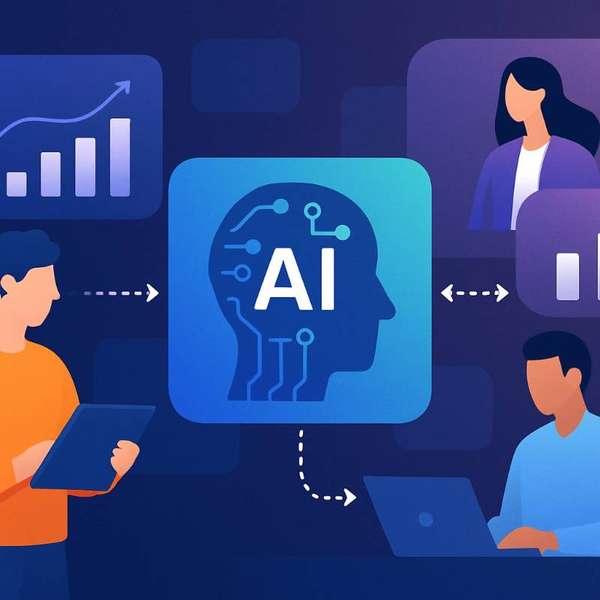
AI-Powered Insight Distribution Across Organizations
March 6, 2026 | By GenRPT
Modern organizations rely on data to guide almost every aspect of their operations. From customer engagement to operational efficiency, data plays a central role in shaping decisions. However, generating insights from data is only part of the challenge. The real value of analytics emerges when those insights reach the right people at the right time. In many enterprises, insights remain confined to reports, dashboards, or specialized teams, limiting their impact across the organization. AI-powered insight distribution addresses this challenge by combining artificial intelligence, AI analytics, advanced analytics, and data visualization to automatically generate and share insights with relevant stakeholders. This approach ensures that teams across departments have access to timely, meaningful information that supports faster and more informed decision-making.
Understanding AI-Powered Insight Distribution
AI-powered insight distribution refers to the use of artificial intelligence and advanced analytics to generate, prioritize, and deliver insights across different parts of an organization. In traditional analytics environments, insights are often presented through static reports that require manual interpretation and distribution. This can create delays and information silos where only certain teams have access to valuable insights.
Artificial intelligence helps overcome these limitations by automatically identifying patterns, trends, and anomalies within large datasets. Once insights are generated, AI systems can distribute them to relevant stakeholders based on their roles, responsibilities, and decision-making needs. This ensures that insights are delivered where they can have the most impact.
Data visualization strengthens this process by transforming complex analytical outputs into intuitive visual formats such as dashboards, charts, and heatmaps. Visual tools allow decision-makers to interpret insights quickly and understand patterns that might otherwise remain hidden in raw data.
Strategic Approaches to Insight Distribution
Organizations seeking to maximize the value of AI-powered insights should adopt structured strategies that support efficient insight distribution.
The first step is establishing scalable data platforms capable of managing large volumes of enterprise data securely. These platforms must integrate data from multiple operational systems to ensure that insights reflect the full business environment.
Next, organizations should implement advanced analytics techniques such as predictive modeling, anomaly detection, and machine learning algorithms. These methods allow AI systems to detect patterns and trends that support operational and strategic decisions.
Equally important is the use of data visualization tools that translate complex analytical results into easily understandable dashboards. Interactive dashboards allow teams to monitor performance indicators and explore insights in real time.
Artificial intelligence further enhances insight distribution by customizing insights for different users. Executives may receive high-level summaries of business performance, while analysts and operational teams receive more detailed reports relevant to their specific roles.
Industry Use Cases
Organizations across multiple industries are already benefiting from AI-powered insight distribution.
In the financial sector, AI analytics systems monitor transactions to detect fraudulent activities and analyze market trends. Real-time alerts and visualization dashboards allow analysts to respond quickly to potential risks.
In retail, companies use advanced analytics to study customer purchasing behavior and optimize inventory management. Data visualization dashboards help managers track sales patterns and adjust strategies accordingly.
In healthcare, AI analytics tools analyze patient records and medical data to support diagnosis and treatment planning. Visualization tools help clinicians interpret complex information more effectively.
In manufacturing, organizations use artificial intelligence to monitor equipment performance and predict maintenance needs. Insight distribution ensures that maintenance teams receive early warnings about potential failures.
These examples demonstrate how distributing insights across departments helps organizations improve operational efficiency, reduce risk, and make faster decisions.
Future Outlook
The future of AI-powered insight distribution will likely involve even more advanced analytical technologies. Machine learning systems are becoming increasingly capable of generating predictive insights automatically and identifying complex relationships within large datasets.
Natural language interfaces may allow users to interact with analytics systems through simple conversational queries, making insights accessible to a broader range of employees.
Emerging visualization technologies such as immersive dashboards and augmented reality may also enhance how organizations explore and interpret data. These tools could allow users to interact with data in more intuitive ways.
At the same time, organizations must prioritize data governance, privacy, and ethical AI practices. Transparent and responsible data management will remain essential as AI-driven analytics systems become more widely adopted.
Conclusion
AI-powered insight distribution is transforming how organizations generate and use data insights. By combining artificial intelligence, advanced analytics, and data visualization, businesses can ensure that meaningful insights reach the right stakeholders at the right time.
This approach helps organizations align strategies, improve collaboration across departments, and make faster data-driven decisions. Instead of limiting insights to specialized analytics teams, companies can create an environment where insights flow throughout the organization.
Solutions such as GenRPT support this transformation by simplifying data analysis, visualization, and insight distribution. By enabling organizations to convert complex datasets into accessible insights, GenRPT helps businesses build a truly data-driven culture and unlock the full potential of their data assets.