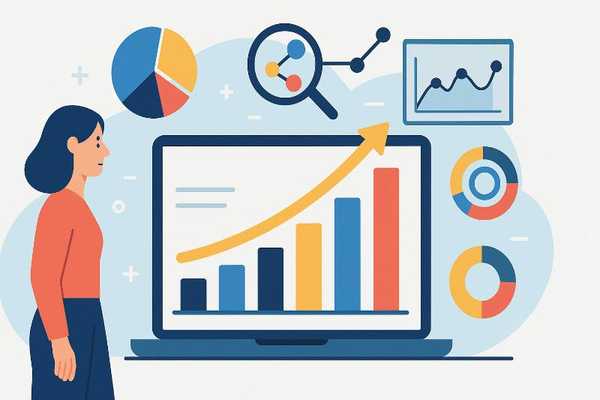
Harnessing Data Analytics for Business Growth
February 26, 2026 | By GenRPT
In today’s fast-paced and highly competitive marketplace, understanding and leveraging data has become essential for success. Businesses are collecting more information than ever before, and extracting valuable insights from this data can be the key to unlocking growth, improving efficiency, and staying ahead of competitors. This is where the power of advanced data analytics comes into play. It enables organizations to interpret complex data sets, forecast trends, and support strategic decision-making. To fully capitalize on these advantages, many organizations are turning to efficient report automation and business intelligence tools that streamline reporting processes, making data-driven insights accessible and actionable.
About the Topic
Harnessing data analytics for business growth is all about transforming raw data into meaningful information that can guide strategic initiatives. Advanced data analytics involves using sophisticated techniques such as statistical analysis, machine learning, predictive modeling, and big data technologies to analyze vast amounts of information. These techniques allow companies to identify hidden patterns, uncover opportunities, and predict future scenarios with high accuracy.
Efficient report automation plays a crucial role in this process. It reduces the manual effort involved in compiling and analyzing data, allowing teams to focus more on interpretation and decision-making. Automated reports generate real-time updates, ensuring that decision-makers always work with the latest information. This not only accelerates response times but also minimizes human errors that can skew insights.
A powerful business intelligence tool acts as the interface where data analysis and reporting converge. It aggregates data from multiple sources, offers visualization options, and simplifies complex datasets. These tools facilitate a streamlined reporting process that is user-friendly and highly effective across departments such as marketing, finance, sales, and operations.
The scope of harnessing data analytics goes far beyond simple reporting. It encompasses predictive analytics for anticipating market changes, prescriptive analytics to recommend actions, and operational analytics to optimize daily processes. Organizations that master these analytical practices gain a competitive edge by making proactive rather than reactive decisions, thereby accelerating growth and enhancing profitability.
Use Cases
Many companies have integrated advanced data analytics into their core operations to drive tangible results. For example, in marketing, analytics can reveal customer preferences and behavior patterns, enabling more targeted campaigns and personalized experiences. This results in higher conversion rates and increased customer loyalty.
In the financial sector, predictive analytics help forecast cash flows and identify potential risks before they materialize. Banks and investment firms use such insights to make better lending decisions and optimize their portfolios. Similarly, in manufacturing, operational analytics identify inefficiencies in supply chains, production lines, and inventory management, leading to cost savings and increased productivity.
Another significant use case is in customer service, where data analytics help identify common issues and improve response strategies. Businesses can analyze customer feedback, support ticket data, and social media interactions to formulate solutions that enhance overall satisfaction.
The rise of business intelligence tools also supports data democratization within organizations. Non-technical staff can access dashboards and reports to make informed decisions without depending on data analysts. This democratization fosters a data-driven culture that encourages continuous improvement and innovation.
Future Outlook
The future of harnessing data analytics for business growth looks promising and transformative. As technologies advance, we can expect more sophisticated tools that leverage artificial intelligence and machine learning to automate complex tasks and deliver deeper insights. These technologies will enhance predictive accuracy and augment human decision-making capabilities.
The integration of real-time analytics will become more prevalent. Businesses will be able to respond immediately to market shifts, customer behaviors, or operational issues. The development of a seamless, streamlined reporting process will further enable organizations to maintain agility and stay ahead of competitors.
Additionally, the expansion of cloud-based analytics solutions will make powerful tools more accessible and affordable for organizations of all sizes. This democratization of technology means even small and medium-sized enterprises can harness advanced data analytics to fuel growth.
Data privacy and ethical considerations will also play a vital role as analytics become more embedded in organizational strategies. Ensuring compliance with data protection laws and maintaining customer trust will remain top priorities.
The growing emphasis on personalized customer experiences will push organizations to refine their data collection and analysis practices continually. Predictive and prescriptive analytics will be integral parts of a comprehensive business intelligence framework, enabling organizations to craft tailored products, services, and marketing messages.
Conclusion
Harnessing data analytics for business growth empowers organizations to make smarter, faster decisions based on reliable insights. By utilizing advanced data analytics, companies can unlock hidden opportunities, optimize operations, and foster innovation. Efficient report automation ensures that data is accessible, timely, and accurate, eliminating manual work and reducing errors. Business intelligence tools act as a bridge, transforming raw data into visual insights that are easy to understand and act upon, all within a streamlined reporting process.
Organizations that adopt these practices position themselves for sustainable growth and long-term success. They create a culture where data informs every strategic move, making the business more agile and resilient in an ever-changing environment. Embracing advanced data analytics is no longer optional but essential for those who aim to thrive and excel in the digital age.
By integrating these technologies and approaches, organizations can stay ahead of the curve, anticipate market trends, and achieve their growth objectives efficiently.
GenRPT helps organizations harness these capabilities by providing a comprehensive platform that simplifies data analysis, automates reporting, and delivers actionable insights in a user-friendly manner. With GenRPT, businesses can implement a truly streamlined reporting process, making data-driven decisions faster and more confidently.