Efficient Report Automation Strategies
February 26, 2026 | By GenRPT
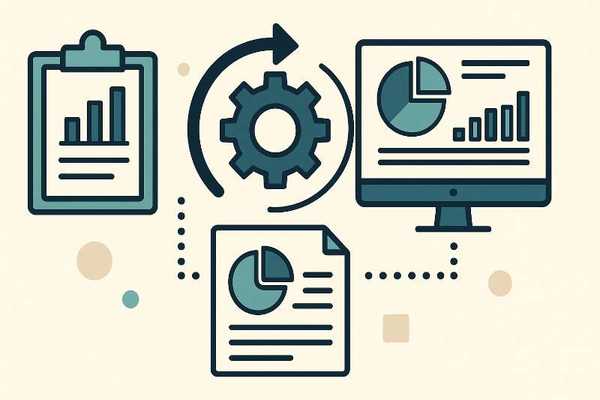
Effective communication of data insights is central to making informed business decisions. As companies grow and data volumes increase, manual report generation becomes complex, time-consuming, and error-prone. That’s where efficient report automation steps in, transforming how organizations handle their information. Leveraging advanced data analytics, integrated business intelligence tools, and streamlined reporting processes, businesses can enhance their operational agility and decision-making capabilities. This article explores various strategies for automating reports efficiently, the importance of this approach, and how it shapes the future of business intelligence.
About the Topic
Report automation refers to the process of using software and systems to generate, distribute, and manage reports without manual intervention. It involves integrating data sources, setting up automated workflows, and employing tools that can analyze vast data sets and present insights in user-friendly formats. The goal is to provide timely, accurate, and relevant information that can support strategic and operational decisions.
In recent years, the importance of efficient report automation has skyrocketed. Organizations handle exponentially larger data volumes, and manual reporting no longer suffices. The advent of advanced data analytics has empowered companies to uncover hidden patterns and trends quickly. Efforts to streamline these processes are driven by a need to reduce operational inefficiencies, cut costs, and accelerate decision timelines. The scope of report automation covers multiple sectors including finance, marketing, supply chain management, and customer relationship management, among others.
Key features of modern automation include real-time data processing, customizable dashboards, collaborative sharing, and integration across various business systems. These features help organizations stay agile in a fast-changing landscape. Automation ensures that decision-makers access the most current information without delays and inconsistencies inherent in manual reports.
Importance and Scope of Efficient Report Automation
The scope of efficient report automation extends beyond mere convenience, impacting operational efficiency and strategic competitiveness. With automation, businesses can reduce the manual workload on employees, enabling them to focus on analysis rather than data collection or formatting. This shift significantly increases productivity and minimizes human errors, ensuring data integrity.
Advanced data analytics play a crucial role by providing deeper insights into customer behaviors, market trends, and operational bottlenecks. These insights, when fed into automated reporting, facilitate faster responses to emerging issues or opportunities. As a result, organizations become more proactive rather than reactive.
A key feature of effective report automation is a business intelligence tool that consolidates data from multiple sources. Such tools enable advanced visualization, automated alerts, and comparative analysis, enriching the decision-making process. Streamlined reporting processes, which combine various automated workflows, ensure that reports are generated consistently, timely, and aligned with business needs.
For many organizations, investing in automation translates to improved compliance and audit readiness. Automated reports are easier to archive, retrieve, and verify. Additionally, automation facilitates scalable reporting structures that grow with the organization, preventing bottlenecks during rapid expansion phases.
Use Cases
The implementation of automated reporting solutions spans across multiple disciplines. In finance departments, automated reports generate daily cash flow summaries, variance analyses, and compliance documentation with minimal manual effort. This enables rapid response to financial anomalies and supports strategic forecasting.
Marketing teams utilize automation to track engagement metrics, campaign performance, and customer segmentation reports in real time. Automated dashboards allow marketers to optimize campaigns on the fly without waiting for periodic report cycles.
Supply chain and logistics operations benefit from streamlined reporting processes by continuously analyzing inventory levels, delivery schedules, and supplier performance. Real-time, automated reports help prevent stockouts or overstock situations, ensuring optimal resource utilization.
The customer relationship management sphere also leverages automation to generate customer satisfaction reports, feedback summaries, and service performance analytics. These insights inform customer service improvements and enhance retention strategies.
Furthermore, organizations adopt business intelligence tools that integrate as a centralized system for multiple departments. Such integration promotes consistency in data interpretation and reduces redundancies and conflicting reports.
Future Outlook
The future of efficient report automation is poised to become even more intelligent and adaptive. Incorporating artificial intelligence and machine learning algorithms will enhance predictive analytics capabilities. Future systems will proactively identify patterns and suggest decisions before issues fully materialize or opportunities are missed.
Automation will also see greater integration with IoT (Internet of Things) devices, allowing for real-time data capture from physical assets like manufacturing equipment or logistics sensors. These data streams will feed directly into automated workflows, providing an even more comprehensive overview of operational health.
Furthermore, the evolution of user-friendly interfaces and natural language processing will democratize reporting. Non-technical users will be able to generate complex reports through conversational queries, expanding accessibility and fostering data-driven cultures.
As data privacy regulations increase, future systems will embed compliance features, automatically flagging or restricting sensitive information. Organizations will thereby maintain regulatory adherence seamlessly within their reporting processes.
Automation platforms will also evolve to offer more customization and scalability. Cloud-based solutions, such as those provided by business intelligence tools, will facilitate easier deployment and updates, ensuring that organizations stay current without significant capital expenditure.
It is foreseeable that the integration of advanced data analytics capabilities with streamlined reporting processes will enable organizations to respond more swiftly to market changes. Industries that adopt these innovations early will gain competitive advantages through enhanced agility and strategic insight.
Conclusion
Implementing efficient report automation strategies is vital for organizations aiming to stay competitive in data-rich environments. By adopting advanced data analytics tools, such as a comprehensive business intelligence solution, companies can automate routine reporting tasks and deliver insights faster and more accurately. The use of streamlined reporting processes ensures consistency, reduces operational costs, and frees valuable human resources for more strategic activities.
For organizations seeking to optimize their reporting workflows, partnering with a solution that seamlessly integrates data sources and offers scalable automation features is essential. Such systems empower decision-makers with timely, reliable information that fuels growth and innovation.
Organizations that prioritize automating their reports will be better equipped to navigate the complexities of modern business landscapes. The future of business intelligence hinges on these technologies becoming more intelligent and accessible, providing even greater value.
In this context, GenRPT is a leading solution that helps streamline reporting processes, enabling businesses to leverage the full potential of advanced data analytics and automation to improve efficiency and decision quality. With GenRPT, organizations can transform their manual reporting challenges into automated, insightful, and strategic assets, paving the way for sustained success in a competitive world.